
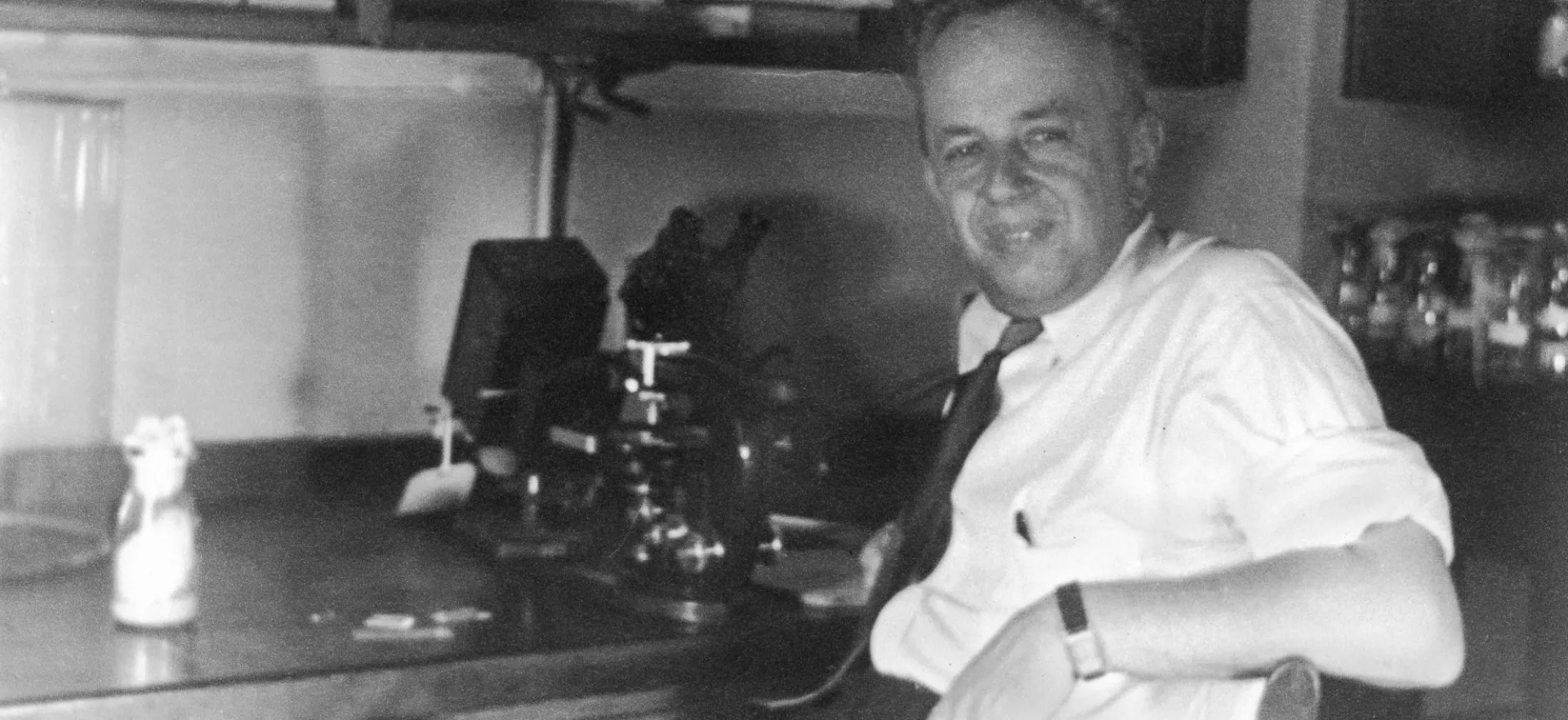
Theodosius Dobzhansky was born in 1900 in the Ukraine and immigrated to the United States in 1927. Arriving in New York he worked with Thomas Hunt Morgan here at Columbia University, who had pioneered the use of fruit flies (Drosophila melanogaster) in genetics experiments. He followed Morgan to the California Institute of Technology from 1930 to 1940. Dobzhansky returned to Columbia University from 1940 to 1962 before finishing his career at Rockefeller University, also here in NYC.
A brilliant scientist and eloquent writer – clearly one of the most significant figures in evolutionary biology – his 1937 work Genetics and the Origin of Species is a pillar of the modern evolutionary synthesis—bringing together fields of genetics, cytology, systematics, morphology, ecology and paleontology.
Though he is most widely known for his work in behavioral genetics, Dobzhansky also wrote passionately about the origins of biological diversity and about the nature of human evolution and variation, its place in science and how that should be relayed to society. His scholarly contributions are part of the foundation of everything we do in this department. To cite one of his most famous quotations, written near the end of his long career: "Nothing in biology makes sense except in the light of evolution."
The Dobzhansky Prize was established in our department in 2015 to recognize excellence in undergraduate research.
Joanna Lin (2026)
Joanna conducted research in both computational biology and evolutionary development. Work on the former with Dr. Molly Przeworski focused on the analysis of trans-species polymorphisms between Rhesus macaques and baboons. Joanna followed this with two years in the lab of Dr. Nandan Nerurkar, where she studied the unusual morphology of the Meckel loop in Pekin ducks, culminating in her impressive thesis, How Mechanical Signals Shape the Gut: Linking YAP Signaling to Evolutionary Variation in Small Intestinal Morphology. Joanna presented her research at the American Society for Cell Biology National Conference and at the SFBD Shaping Life Conference. With her ‘energetic enthusiasm’ Joanna has also shared her love of scientific research through her roles as President of Columbia’s Sci-Inspire and as Editor in Chief of the Columbia Junior Science Journal.
Lauren Subramaniam (2025)
Lauren completed extensive coursework in evolution, animal behavior, neurobiology, and genetics Her thesis, titled Evidence of satyrization resistance behaviors in field-collected Aedes aegypti mosquitoes, was based on several years of work in Laura Duvall’s lab in Columbia’s Department of Biology. Her thesis, co-mentored by Prof. Duvall and Thomas Gabel involved several elegantly-designed laboratory experiments to understand mating behaviors in the yellow fever mosquito which, from the public health perspective, the most dangerous animal on Earth. Lauren’s work was consistently well-written, well-explained, and beautifully illustrated. Lauren has won several research Fellowships over her time at Columbia, and also performed research on mate choice in Drosophila flies in the Dr. Alison Pischedda’s lab at Barnard, and on ants and ticks while studying in Kenya with Dr. Dustin Rubenstein in E3B’s Tropical Biology program in Kenya.
Ana Reif (2024)
Ana was a pivotal member of the Crypts Osteology Group starting from her first semester. Given her keen mind and passion for paleoanthropology, Ana was eventually entrusted with creating the catalogue for E3Bs hominin fossil cast collection. Ana also sought out research opportunities off campus, participating in REUS at the American Museum of Natural History in 2022, with research continuing over the next year, and at the University of Texas. The research from the latter, in their SOAR program, led to a poster session at the AABA meetings in her senior year. Though this research could have been the basis for her senior thesis, ever seeking to expand her knowledge, Ana undertook a dramatically different project entitled, Femoral Bicondylar Angle and Terrestriality in Extant Primates conducted under the mentorship of an EBHS alum Dr. Jeffrey Spear.
Ashley House (2024)
Ashley completed extensive work in both vertebrate biology and paleontology. Her classes span from the “ologies” offered through E3B – Herpetology, Ichthyology, Mammalogy – to the classes in Earth and Environmental Science that relate to ancient life and methods for studying it – Paleobiology, Geochronology, and – of course – a course on dinosaurs. Ashley’s research interests led her to a thesis project titled: Mapping African Environments: A Stable Isotope Study of Modern Crocodilian Enamel and its Potential for Paleoecological and Paleoenvironmental Reconstructions. This work, conducted with mentors Daniel Green and Kevin Uno from Harvard, was both technically and intellectually challenging, and led to a beautifully-written thesis with excellent potential contributions to the published scientific literature.
Isabelle Seckler (2023)
Isabelle’s research focused on mosquito-borne disease. Isabelle began with a Summer Undergraduate Research Fellowship (SURF) in Biology with Dr. Laura Duvall from Columbia’s Biology department, which led to further independent study and culminated in a senior thesis. Isabelle took on an ambitious research project focusing on understanding the signaling pathways that regulate host attraction and nutrient utilization in Aedes aegypti. For her senior thesis research, Isabelle performed sophisticated microinjections so that she could ask whether manipulating this pathway alters mosquito attraction to humans. She designed well-controlled and informative experiments, presented her research at professional meetings, and passed on her expertise to many other lab members.
John Nguyen (2023)
John’s research interests spanned both vertebrate biology, especially herpetology, and ecosystem ecology. John performed research on malaria resistance at Columbia’s medical center, collaborated with several mentors at the Cary Institute on a multi-year study on leaf herbivory and nutrient concentrations in tropical forests, and completed two projects with Dr. Rayna Bell at the California Academy of Sciences. The first of these, which began as an REU project, used molecular sequencing and analysis of museum specimens of reed frogs (genus Hyperolius) from Equatorial Guina to describe the diversity and distribution of this little-studied group. John’s second project with Dr. Bell culminated with his senior thesis on the historical prevalence of the chytrid fungus in amphibian populations of West Africa.
Emily Stone (2022)
Emily’s research during her years at Columbia spanned neurobiology, disease ecology, and paleoceanography, with several of her research projects happening in her native Hawai’i. Her first project on studied categorical learning in honeybees under the supervision of Dr. Patricia Couvillon at the University of Hawai’i at Manoa. Emily then worked with Dr. Maria Diuk-Wasser’s Ecoepidemiology lab in E3B on the social determinants of Lyme disease risk. Emily also worked with a team from Lamont Doherty using marine sediment cores to study past changes in Arctic Ocean circulation. For her senior thesis, Emily returned to the University of Hawai’i at Manoa to work with Dr. Matthew Medeiros studying the effects of diet on the gut microbiome of the Asian tiger mosquito.
Angelina Hines (2020)
The breadth and depth of Angelina’s research experience is impressive. She served as a research assistant to Prof. Marina Cords analyzing behavioral data on blue monkeys, and completed an REU in biomedical engineering at Stony Brook University. Angelina followed this with field schools in paleoanthropology at Koobi Fora, Kenya, and osteology in Astypalaia, Greece. Her experience at the latter with child burials, led to a graduate course in dental anthropology at NYU and research that resulted in a poster on variation in Anatomically Modern and Neandertal deciduous molars for the AABA meetings. Though fascinated by prehistory, Angelia sought ways to apply her knowledge to the present. With her typical initiative, she established relationships with researchers at the College of Dental Medicine, leading to her impressive senior thesis, An Analysis of the London Atlas to Estimate Dental Age Using Radiographs from a Contemporary, Ancestrally-Diverse Population from New York City. The ultimate goal of this research is to aid in the identification of minor migrants globally.
Dominique Jeton Groffman (2019)
Dominique has done a wide range of research while here at Columbia. In her sophomore year, she worked with Dr. Daniel Kalderon in the Biology department on Drosophila genetics, the main model system for Prof. Dobzhansky. In her junior and senior years, she did extensive work with Dr. Barbara Ambrose at the New York Botanical Garden. Through this work, Dominque studied plant evolution, the morphology of land plants, the evolution of gene lineages, phylogenetic analyses, plant developmental biology, and morphological analyses. Dominique is a gifted researcher with a deep and abiding curiosity about evolutionary biology, a tremendous work ethic, and an excellent set of field, laboratory, and analytical skills.
Richard Li (2018)
Richard’s academic interests covered both plants and animals, and his research spanned ecosystem science, ecophysiology, and behavioral ecology. Richard studied nitrogen fixation in tropical trees with Dr. Duncan Menge of E3B and the response of both temperate and boreal trees to climate variation over a multi-year collaboration with mentors at the Lamont-Doherty Tree Ring Lab. For his senior thesis, Richard studied the effects of urbanization on pigeon behavioral responses under the direction of Dr. Jason Munshi-South and Elizabeth Carlen from Fordham University. Richard’s thesis research was published in a paper titled Urbanization predicts flight initiation distance in feral pigeons (Columba livia) across New York City in the journal Animal Behavior.
Dorothy Fang (2017)
Dorthy completed research with several laboratories across Columbia. Her intellectual breadth is reflected in the courses she completed – the major requires five advanced courses in our own and allied disciplines; Dorthy completed fifteen such courses, spread across E3B, Earth and Environmental Sciences, and Economics. Dorthy studied the effects of oil spill on bacterial growth and physiological activity with Dr. Andrew Juhl at Lamont-Doherty and using stable isotope signatures of leaf waxes to reconstruct the Arctic paleoclimate record with Dr. William D’Andra, also at Lamont-Doherty. For her thesis, Dorthy completed a multi-experiment thesis on seed movement through urban landscapes in collaboration with Dr. Matt Palmer from E3B. Dorthy has also been involved in several undergraduate organizations such as CUEBS, the Eco-Reps, and as a student officer and cellist in the Columbia Bach Society.
Leigh West (2016)
Leigh pursued research across the globe during her time in E3B – spanning from Africa to the Arctic to the Antarctic. She performed independent research with Dr. Howard Rosenbaum at the Wildlife Conservation Society on acoustic recordings of Arctic mammals, establishing important baselines for these species in a rapidly changing climate. She performed thesis research on interactions between baboons and leopards in South Africa under the mentorship of Drs. Katy and Sam Williams from Durham University. During the January break of her senior year, Leigh participated in an oceanographic research cruise in Antarctica with Dr. Hugh Ducklow from Lamont-Doherty studying marine plankton and ecosystem dynamics.
Rachel Bell (2016)
Rachel’s research spanned both human and non-human primates. She began by studying extant primates at the Fireburn Reserve in Belize and for the next two years worked with Prof. Marina Cords analyzing data on the behavior and life history of the blue monkeys of Kakemega Forest, Kenya. This research led to Rachel’s stellar senior thesis, Factors Effecting Activity Budgets in Female Blue Monkeys. Always setting new challenges for herself, during her senior year Rachel also worked as a research intern at EcoHealth Alliance assisting in research to predict the movement of Zika Virus infected travelers around the world. She was also co-author on a journal article assessing the success of virus mitigation expenditures in reducing risk.
Caitlin Miller (2015)
Since arriving on campus, Caitlin was tenacious in her pursuit of research opportunities. She started volunteering at the AMNH her first month at Columbia. Caitlin followed this with studies of primates in Kenya and osteological excavations at Astypalaia, Greece. During her junior and senior years, Caitlin was involved in two on-going research projects: A zooarchaeological analysis of the White Sands collection and the one closer to her heart as it became the basis for Caitlin’s superb senior thesis—research on skeletal variation in Tropidurid lizards, Abdominal Skeleton Variation in Neotropical Ground Lizards (Tropidurus). Both of these resulted in publications, with Caitlin the lead author on the latter. Caitlin’s intellectual rigor and commitment consistently elevated her research to a new level.
Alexandra DeCandia (2015)
Allie’s academic interests spanned ecology, genetics, and conservation biology. Her first research project was studying how Arctic arthropod communities change in response to a warming climate with Dr. Natalie Boelman from Lamont-Doherty. Following that, Allie worked on a multi-year project with Dr. George Amato at the American Museum of Natural History to develop molecular tools for identifying the sex of wild carnivores from scat samples. This research, which was published soon after Allie’s graduation in Conservation Genetics Resources, allows wildlife biologists to determine the sex ratio of wild carnivore populations non-invasively. In addition to her research, Allie was also active in science communication, blogging about science for multiple publications.