
Master of Arts in Ecology, Evolution, and Conservation Biology
The Master of Arts in Ecology Evolution and Conservation Biology at Columbia University integrates biological sciences with environmental conservation and policy, project planning, and research or practical experience. This interdisciplinary approach provides students with a range of options for building their careers. Graduates from our program continue their education in a Ph.D. program or enter the job market directly as scientific researchers, teachers or administrators in a NGO or government agency dedicated to the conservation of natural resources. The M.A. program at E3B is project-based, meaning that all students must complete a capstone project as a major requirement for the degree. Students have the option of tailoring their course work to develop their interests, and to craft a capstone project that allows them to gain additional skills and experience.
Interdisciplinary Flexibility
Customize your coursework to match your interests. Develop the skills needed to pursue a Ph.D., gain real-world conservation experience for careers with NGOs, or focus on applying science in policy, education, or government settings.
Research Opportunities
Work alongside a diverse faculty on topics spanning macroecology, beetle biodiversity, whale behavior, ethnobiology, and ecosystem services. Students benefit from research collaborations with major New York institutions including the Wildlife Conservation Society, the American Museum of Natural History, and the New York Botanical Garden.
Supportive Community
While Columbia is a major research university, the M.A. program offers the close-knit feel of a small department. Students enjoy small classes, individualized advising, a dynamic lecture series featuring leading researchers, and a vibrant community that supports both academic and career development.
The M.A. in Ecology, Evolution and Conservation Biology provides for flexibility in tailoring the lineup of courses that is most appropriate for each student’s interests.
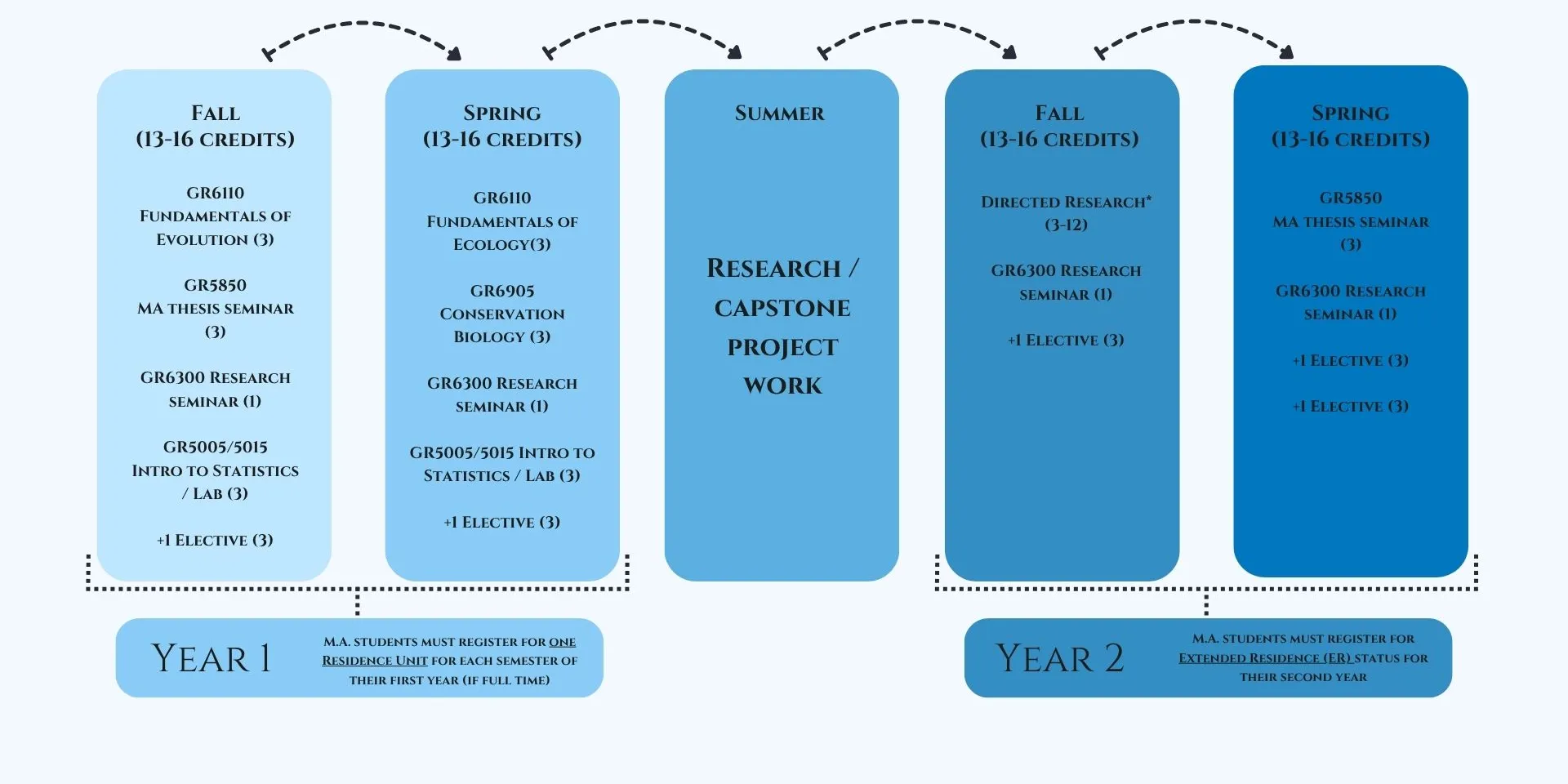
To earn their M.A. degree students must complete a minimum of 4 semesters, including a minimum of:
- 2 Residence Units (RUs): Equivalent to two semesters of full-time enrollment.
- 2 Extended Residence Units (ERUs): Registration status for each semester in the second year at reduced tuition.
- 43 Points (Credits): Including core courses and electives.
Required Courses:
- Fundamentals of Ecology (EEEB GR6112; 3 credits)
- Fundamentals of Evolution (EEEB GR6110; 3 credits)
- Conservation Biology (EEEB GR6905; 3 credits)
- Four semesters of Research Seminar (EEEB GR6300; 4 credits total)
- Thesis Development Seminars I and II (EEEB GR4850 and EEEB GR4851; 6 credits total)
- Statistics (EEEB 5005/5015 or an approved advanced course; 3 credits)
Electives:
- At least one Policy elective
- At least one Ecology/Behavior/Conservation Biology elective
- Research credit for field work, data collection and research activity
- Additional electives to meet the 43-credit requirement
- Electives can be taken within the E3B Department and University, and outside at AMNH or NYBG
The capstone project is a central component of the MA program, allowing students to undertake a substantial research, outreach, or education activity. Projects can take the form of a Research Thesis or a Practical Thesis and must be approved by a three-member committee, including at least one core E3B faculty member. Students typically conduct fieldwork during the summer between the first and second years, with the option of a research semester in the second year. The final project includes a written summary and a presentation to the E3B community.
Application Deadline
- Mid-January for Fall admission. Please check the Graduate School of Arts and Sciences (GSAS website) for specific dates.
- A background in ecology and evolutionary biology is preferred. This may include relevant undergraduate coursework (such as introductory biology, ecology, evolution, and genetics) or hands-on experience in research, fieldwork, conservation, or related applied settings.
- GRE General and Subject tests are not required.
- Applicants are strongly encouraged to contact potential faculty mentors before applying.
Application Requirements
- Transcripts from all post-secondary institutions attended
- Statement of academic purpose
- Personal statement
- Two letters of recommendation
- Resume or CV
- English proficiency test scores (TOEFL or IELTS) for applicants whose undergraduate degree is from an institution in a country where English is not the official language
Apply through the Graduate School of Arts and Sciences (GSAS) application portal
The M.A. program offers limited internal funding and encourages students to pursue additional external support. Available funding opportunities include:
- Conservation Biology Scholarship: A $10,000 internal scholarship supporting M.A. students conducting research or applied projects in conservation biology. Projects should address pressing conservation challenges such as biodiversity loss, habitat degradation, climate change impacts, introduced species, human–wildlife interactions, or conservation policy and management. Research may be field-, lab-, data-, or policy-based and should demonstrate clear relevance to real-world conservation outcomes. To apply, students must submit a 300-word conservation statement describing the conservation problem motivating their work, the ecological or societal significance of the issue, and how the scholarship would support their graduate-level training or research. Applications should be submitted to the Director of the M.A. program (Bekka S. Brodie, [email protected]) by January 15. Interested applicants are encouraged to consult with the DMAP and relevant faculty mentors prior to applying.
- Amazon Conservation Scholarship: A $10,000 internal scholarship supporting M.A. students conducting research on integrated forest landscape restoration in the Peruvian or Brazilian Amazon. Proposals should focus on topics such as reforestation, biodiversity conservation, community engagement, ecosystem services, or sustainable resource management. To apply, students must submit a 2-page research proposal to the Director of the M.A. program (Bekka S. Brodie, [email protected]) by January 15. The award supports fieldwork during the summer of 2025. Interested applicants are encouraged to consult with the DMAP and potential faculty mentors before applying.
- E3B M.A. Student Research Grant: Up to $2,000 to support the capstone project, with a possible $400 match from the GSAS.
- Travel Grant: Up to $450 from the department, with an optional $300 match from GSAS, to support student travel for presenting at scientific meetings.
- Reading Assistantships: Paid positions supporting undergraduate courses that offer valuable teaching experience and a modest stipend. Positions are announced annually and are filled competitively.
The E3B MA program offers the student-centered experience of a small department within a major university. Students participate in events hosted by GRASS (Graduate Resource Association of Student Scientists), join departmental seminars and retreats, and contribute to social and intellectual life in the department. Resources for housing, healthcare, and well-being are available through Columbia’s Student Services and GSAS.
For more information about the MA program, please contact:
- Dr. Bekka Brodie, Director of the MA Program (DMAP), [email protected]
Below, you can watch some videos created by our students and alumni. For more videos check out our YouTube Channel.