
Sarah Trabue Wins 2nd Place in the University SynThesis Competition
Congratulations to E3B MA student Sarah Trabue on winning 2nd place in the University SynThesis competition!

Check out her project below:
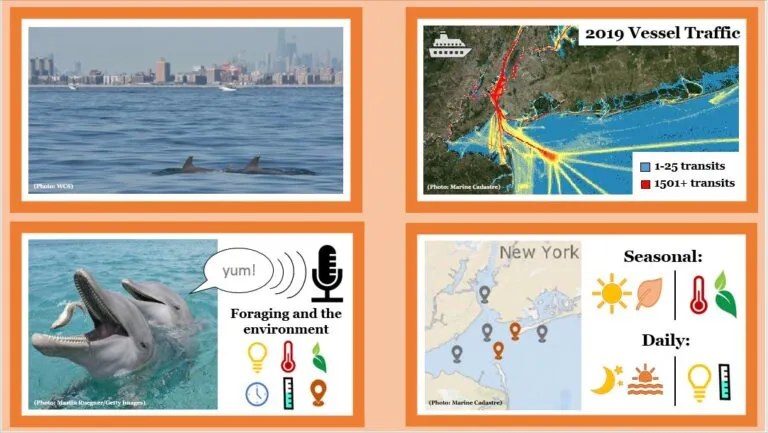
Environmental drivers of bottlenose dolphin foraging behavior in an urbanized estuary by Sarah Trabue, Melinda Rekdahl, and Howard Rosenbaum
Marine predator foraging behavior, which can be linked to environmental conditions, influences community structure and ecosystem functioning. Determining the conditions under which predators forage can facilitate the identification of important habitats. Here, we used passive acoustic monitoring to identify optimal foraging conditions for bottlenose dolphins (Tursiops truncatus) within the New York-New Jersey Harbor Estuary. Foraging activity occurred on the majority of days that dolphins were detected and was significantly associated with seasonal environmental conditions. Our results suggest that this urbanized estuary serves as an important
foraging ground for bottlenose dolphins and that seasonal environmental conditions can be important determinants of foraging habitat. Further research is needed to better understand diel foraging patterns and the influence of anthropogenic disturbance on foraging behavior. Understanding how marine predators interact with the biotic and abiotic features of this human- dominated habitat is particularly important given the expansion of anthropogenic activities, including offshore wind energy development.